

Amazing Gadget Corporation has determined it requires an introduction plan for a new product. That’s a mutual setup in promotion readers, and it packs three real conclusions into one development: pricing, promotion, and dissemination.
A speedy note before we dive in. Astounding Gadget Corporation isn’t a real occupation. It’s a hypothetical company that shows up in business courses to teach product-launch strategy. This guide uses it the same way, as a teaching example, and every concept below comes from real, established marketing theory.
Understanding the Amazing Gadget Corporation Scenario
Amazing Gadget Corporation has determined three things before launch: what price to charge, how to promote the product, and how to reach buyers. Every product launch faces this same triangle.
Marketing courses use fictional companies like this one for a reason. A made-up name keeps the focus on the decision framework, not on any single company’s actual results. That’s exactly what varieties are useful now.
Here’s the key features table for the core concepts you’ll need:
| Concept | What it means | When it fits |
| Penetration pricing | Low launch price to win the customer base fast | New market, many competitors |
| Price skimming | High initial price that drops over time | Unique product, few rivals |
| Diffusion of innovation | How customer segments adopt a new product over time | Any new product launch |
| Distribution channels | The paths a product takes to reach buyers | Every launch |
| Promotion mix | The blend of ads, selling, and word-of-mouth used | Every launch |
Choosing a Pricing Model: Penetration vs. Price Skimming
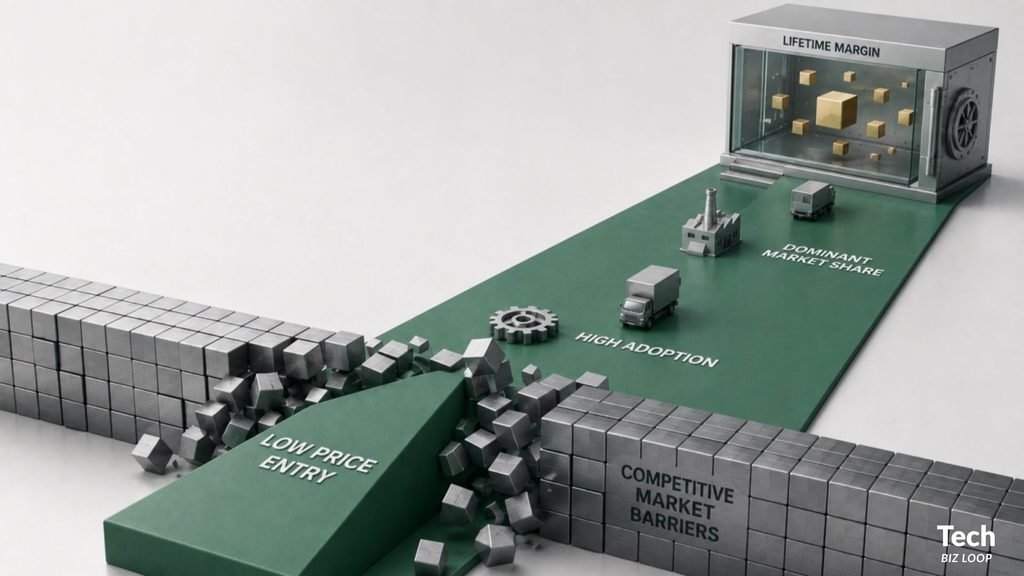
A pricing model shapes everything else in the launch. Two characteristic options dictate this decision: penetration pricing and price skimming.
Penetration pricing groups a low preliminary price to speedily build an existing customer base. GeeksforGeeks describes it as a strategy that sets low prices to bring in new customers and grow market pricing share fast. It works well when demand is elastic and rivals already crowd the space.
Price skimming does the opposite. It sets a high initial price at launch, then lowers it step by step. Wikipedia notes that skimming suits products with a limited supply and a short life cycle, since early adopters will pay a premium pricing rate to own something first.
There’s a third option worth naming: survival pricing. This happens when a company prices low enough just to keep sales moving and cover costs, not to build share or maximize profit. It’s an apologetic move, not an evolutionary strategy.
Expert insight: Physical launches rarely follow either definitive path perfectly. One pricing-strategy study found that despite decades of advice favoring skimming or penetration, most companies actually launch near the going market pricing rate instead. Theory and practice often diverge here.
Penetration Pricing vs. Price Skimming Compared
| Factor | Penetration Pricing | Price Skimming |
| Starting price | Low | High |
| Main goal | Fast market penetration | Maximize early profit |
| Best demand type | Elastic | Inelastic |
| Risk | Sets low price expectations long-term | Slower adoption at first |
Building a Customer Base Through Technology Adoption
Winning a customer base takes more than a good price. It also depends on technology adoption patterns, meaning how different types of buyers try new things at different speeds. Vendors group consumers into customer
segments based on implementation speed. Innovators obstacle first, often before an invention proves itself. Later segments wait for reviews, price drops, or peer pressure before buying in.
Complementary products speed adoption too. A capsule sells faster when decorations, apps, and services now support it. That’s why a strong product ecosystem often has problems as much as the device herself.
Three factors influence how fast technology users adopt something new:
- How much value the product adds over what they already own
- How visible other people’s use of it is
- How easy the product is to try before fully committing
Overcoming Switching Barriers and Customer Retention
Switching barriers stop people from moving to a new product, even a better one. Overcoming them matters as much as pricing it right.
Adoption costs and transition costs both slow customer migration. Learning a new interface, losing saved data, or retraining a habit all count as real costs, even without a dollar sign attached.
Backward compatibility helps here. When a new gadget still works with legacy products or previous-generation games, it removes a major switching barrier. Buyers don’t have to abandon what they already own.
Once someone switches, customer retention becomes the next goal. A loyal customer network also brings a side benefit: it generates buzz that pulls in the next wave of buyers.
Reaching Buyers: Distribution and Communication Channels
A prodigious product still requires the right distribution channels to influence buyers. This decision silhouettes how, and how fast, an inauguration gains adhesion.
Selective reach resources choosing detailed outlets or platforms in its place of trying to sell ubiquitously at once. It works well for finest or niche harvests, where a wide, fuzzy rollout would dilute the variety.
Communication channels run in equivalent amounts of frequencies. A channel strategy should bout both together: sell where your consumers shop, and talk to them wherever they already pay consideration.
Promotion Strategy: How Buyers Actually Hear About It
Amazing Gadget Corporation has determined its fee and its frequencies. Preference comes next, and it regularly blends some tactics rather than relying on impartial ones.
Word-of-mouth remains one of the toughest upgrade tools, and it expends nothing unswervingly. Happy premature buyers convert unpaid believers, and their personal contacts trust them more than whichever ad.
Influencer marketing and social media marketing extend that same trust dynamic at scale. A well-chosen Influencer means like a very perceptible, very winning personal connection.
Digital promotion concealments a widespread toolkit: digital advertising, social media advertising, content marketing, and all-purpose internet marketing. Every target is an unlikely stage of the consumer’s verdict.
Direct selling concluded sales representatives or a committed sales team still troubles for complex or affluent products. Personal selling consents real-time customer education, answering demands and never can.
Common Mistakes to Avoid
A few mistakes show up again and again in these case studies. Watch for them.
- Picking a pricing model without checking whether demand is actually elastic or inelastic
- Ignoring switching costs when targeting customers already loyal to a rival product
- Relying on one promotion channel instead of blending several for better customer conversion
Frequently Asked Questions
Is Amazing Gadget Corporation a real company? No. It’s an imaginary example used in promotion and business progressions to teach launch strategy thoughts.
What’s the main difference between penetration pricing and price skimming? Infiltration pricing starts low to win patrons fast. Price scanning starts high to capture early turnover, then lowers over time.
Why does backward compatibility matter for new products? It sinks substituting costs. Buyers keep using their present fixtures or files, so they lose less by advancement.
Which promotion method works best for a new product? No solitary method wins alone. Most efficacious introductions blend word-of-mouth, digital advertising, and own selling collected.
What does market penetration mean in this context? It earns a larger share of existing patrons in a souk, usually chased by a low new product pricing policy at promotion.
Conclusion
Amazing Gadget Corporation has determined its price, its frequencies, and its elevation mix, and that’s the equivalent three-part decision all real product introduction faces. Estimating sets potentials, spreading decides reach, and preferment builds the buzz that turns interest into deals.
None of these results work well in segregation. A great price with poor circulation still fails, and a durable promotion push can’t fix a channel policy that doesn’t reach the right consumers. Delicacy all three as one allied plan, and any launch, real or proposed, stands a much recovering shot at triumph.









Leave a Reply