


Low code vs no code Today’s platforms support a vast proportion of applications developed for businesses. In fact, Gartner predicts that by 2026, about 75% of new enterprise applications will utilize low-code platforms, a statistic that has remained unchanged according to many credible sources out there.
This shift is not insignificant. Choosing a particular tool impacts the speed of shipping as well as the development of your app. Let’s sort out what distinguishes both methods.
What Is Low-Code?

Although low-code platforms provide a graphical development tool to create applications, coding is still necessary in some situations. When the simple graphical tools don’t allow you to achieve your goals, low-code platforms allow you to use your own individual coding abilities.
This flexibility is exactly what makes low-code platforms attractive.Software development professionals can obtain fast results while still being able to solve complex tasks.
Read Also : Delete Chrome Cookies
What Is No-Code?
Platforms that don’t involve any coding are those that eliminate the use of code completely. The processes rely on the use of templates, visual logic builders, and configuration panels which means a user with no technical experience can implement it.
Thus, the platforms are created for business users and therefore, the marketing manager or HR coordinator can create an effective tool without waiting in an IT queue.
Low-Code vs. No-Code
How Are Low-Code & No-Code Development Similar?
Both depend on graphical interfaces to hasten up. Both aim to reduce the traditional development bottleneck down to size. And both are leaning very strongly on AI-assisted features, which Gartner in its latest Magic Quadrant evaluation criteria weighed at around 35%.
How Are Low-Code & No-Code Development Different?
Here is the real alteration: low-code exposes an underlying code tier that you can physique upon. No-code, on the other hand, conceals it altogether by design.
This essential distinction creates a drastic cascade effect. Low-code opens the door for complicated programming. Instead, no-code is easier to use, though it has limited options when the template is not enough anymore.
How Low-Code Tools Work
The real work is accomplished by visual builders: you don’t have to worry about building components, designing workflow, or getting connectors because these builders will take care of all of that.
How No-Code Tools Work
No-code options use configuration instead of code: it’s sufficient to create if-and-then builders, use ready-made templates, and employ configuration panels. All underlying technical work is performed by a platform.
How to Choose Between Low-Code or No-Code Tools
Making the right choice depends on which department you’re building for.
Supply Chain
No-code is good for the fundamentals: inventory control sheets and simple approval processes and even vendor orders. But once you’re aiming to have real-time data synced between the ERP and a warehouse solution, low-code is a much better fit.
Manufacturing
Quality control sheets and shift reports work well using no-code but when it comes to connecting to IoT sensors or real-time manufacturing data it is better to turn to low-code because it offers better integration possibilities.
Accounting and Finance
Expense approvals and simple budget trackers are fine for no-code type applications but if it comes to dealing with sensitive financial information low-code is the only choice due to strict compliance regulations such as SOC 2 and GDPR.
Human Resources (HR)
Onboarding checklists as well as time-off request forms belong to traditional no-code solutions. The integration of the already existing payroll or Human Resources information system with its customized data mapping relates to low-code areas of activity.
IT
Usually, the low-code layer construction and management is the responsibility of the IT department. It constructs and controls the applications used by other departments and very often applies all the capabilities of both no-code and low-code approaches in one application or process.
Process Automation
No-code can be applied only for uncomplicated processes which include one department only. Any workflow that requires conditional logic needs a low-code approach and this is why the software that was created specifically for automation relies on low code development.
Benefits of Low-Code and No-Code Development Tools
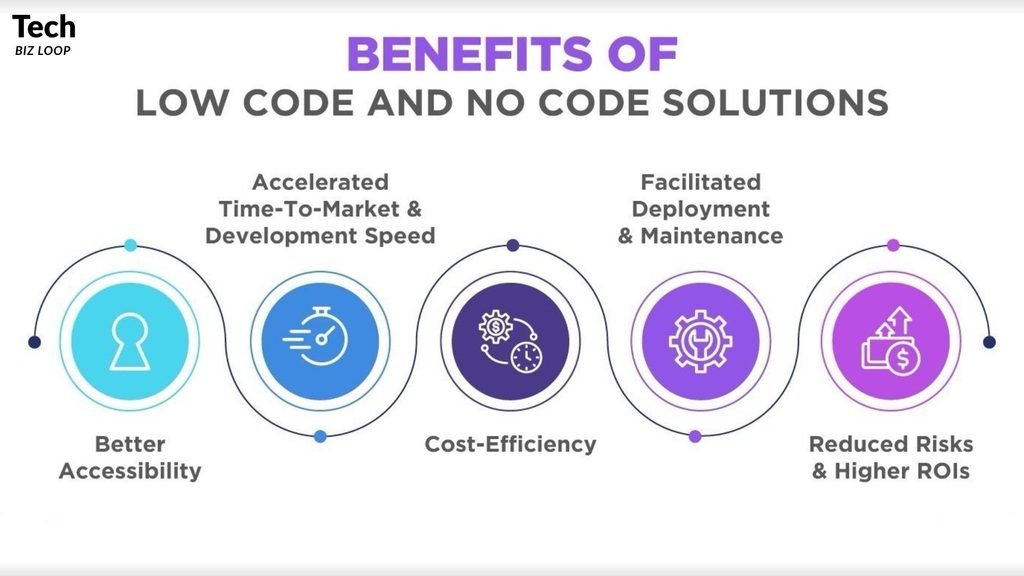
Here’s a quick table laying out the low code no code benefits side by side:
| Benefit | Low-Code | No-Code |
| Delivery speed | Fast | Fastest |
| Developer dependency | Reduced | Eliminated |
| Scalability | High | Limited |
| Compliance support | Strong | Varies widely |
| Skill required | Some technical knowledge | None |
Research-based insight: The benefits are beneficial both ways.Whichever way, with closer delivery, less requirement on the inventor’s backlog, and more elasticity when the business fluctuates.
Get Started with Low-Code and No-Code Development Tools Today
First, match your own case with the department breakdown demonstrated earlier. This one step saves a lot of inconvenience from tools being mismatched.
Helpful hint: trial a few platforms before you commit to one. Power Apps and other similar platforms could work well for many low-code cases while Airtable handles an impressive number of no-code tasks.
Do not forget to involve IT from the very beginning, even for simple no-code project. Complications with governance and data sanctuary arise instantly when the tool is elsewhere on the desk of one creature.
Comparison: Low-Code and No-Code at a Glance
| Factor | Low-Code | No-Code |
| Coding required | Minimal, but possible | None |
| Target user | Developers, IT teams | Business users |
| Customization ceiling | High | Low to moderate |
| Best use case | Complex, compliance-heavy apps | Quick internal tools |
Use Cases: A Real-World Example
Case study: Imagine an HR team buried in paper leave request forms. They create a basic no-code form in a day without involving a developer.
On the other hand, the finance department at the same company needs a unique integration between their accounting software and a new vendor portal. This project is done by the IT department on a low-code and no-code software development platform.
The same company has two very different tools which address real problems in the proper way.
Tips for Choosing the Right Platform
Exclusive the tool that is appropriate for the level of happenstance to discourse as contrasting to indicating approximately that is up-to-the-minute or extensive. A simple form should not be powered by an architecture for the enterprise.
According to experts, organizations that do not combine the two correctly, usually either over-engineer a simple solution, or struggle with one that is designed for a much simpler job.
Common Mistakes to Avoid
Selecting a no-code platform for something that will quickly surpass it is a recipe for a costly rebuild down the line. Opting for an expensive enterprise platform for a basic internal solution causes an equally wasteful situation.
Migration issues may also not be immediately apparent. Moving away from some no-code low-code platforms may not necessarily be easy, so always make sure to check this beforehand.
Low-Code and No-Code FAQ
What is the difference between low-code and no-code? Though low-code can refer to platforms that will still need some programming expertise at times, they mainly serve developers. The meaning of no-code, on the other hand, indicates platforms that require no technical skills whatsoever.
Who are low-code platforms for? For example, using low-code platforms are mainly directed at qualified personnel, who know everything about software development and how to deal with even the most complicated tasks requiring particular customized features or licenses.
Who are no-code platforms for? Business users and citizens can create uncomplicated in-house Applications deprived of support from any IT specialists.
What are the main benefits of using low-code and no-code platforms? Low-code increases the speed of transport and improves the logjams of inventors. No-code makes it easier to variety this process open for any participant across the association.
How do low-code and no-code platforms help businesses innovate? All levels of the institution are now empowered to test each and every idea and do not have to wait for their turn in the IT queue.
Can low-code and no-code platforms be used together?Undoubtedly, numerous institutions are taking this approach, using no-code for quick internal functions and utilizing low-code when dealing with more complex tasks related to end customers along with the compliance aspect.
A Quick Note on AI-Powered Subscriptions
Searching for an IA development low code no code subscription has increased along with the growth of these services. The common of major corporations now include AI competences as part of their average pricing in its place of charging disjointedly.
Ready to Choose the Right Platform for Your Team?
Conduct another core decision test: the complexity and required compliance processes suggest low-code. The factors of simplicity and speed suggest no-code.
Jump small. Pilot a project in the subdivision most likely to benefit from it in its place of launching a dais across the corporation on the principal day.
Conclusion
Low code and no code are not opposing tools; they are used as provisions for each other. These have different uses, so the growing companies end up using both of them in tandem.
Assign the tool to its task: low code for complex and regulatory tasks and no code for straightforward and speedy jobs. If you manage to do that, you’ll have a better success rate.









Leave a Reply